
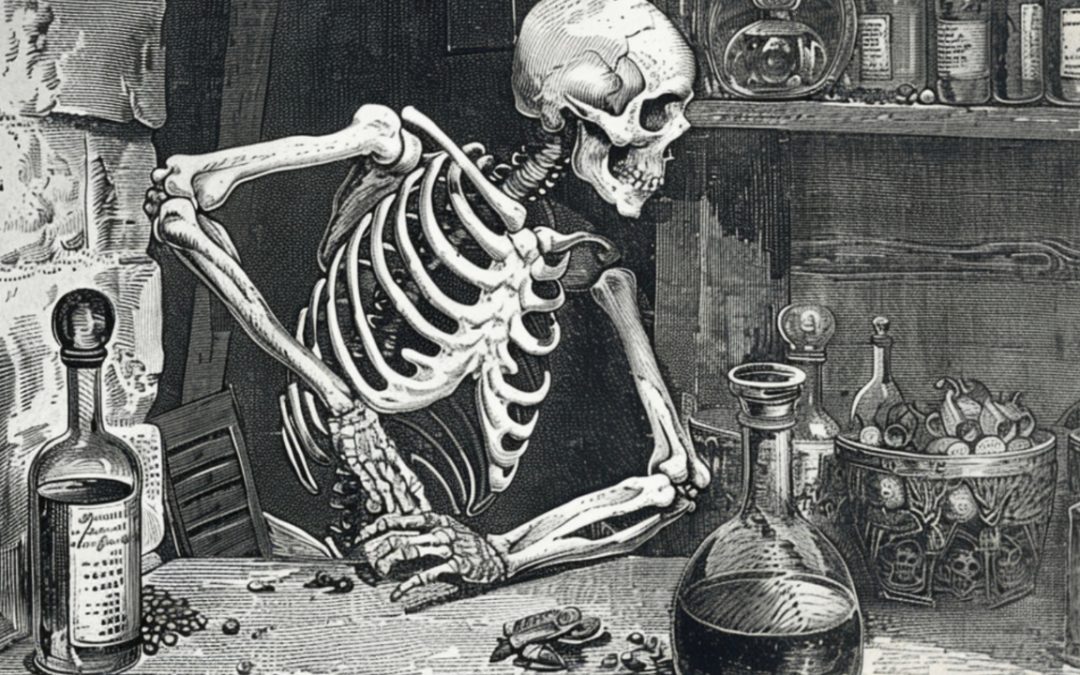
This compendium of gruesome happenings pulls the worst crimes from Guardian City’s past, but lacks artistry, proof, and any sense of morality, writes Cornelius Goodwin
Horatio Fairchild, the author of Gruesome Tales of Fatal Deaths, salivates over a whole series of fiendish Guardian City crimes dating back over 200 years for this sickening work.
He should not be commended or encouraged. If there is artistry or thought to be found here, it is purely accidental, like the drips of blood by a mangled corpse that form a murderer’s name.
This, by the way, was a highly dubious conjecture that he makes in one of the early stories – Message from Beyond. (Note to author: Two blobs and a smear, do not the name “Leonardo” make).
Gruesome crimes, gruesome writing
The tales are ripped without elaboration or context from archives, journals, pamphlets, and court records.
In one particularly grim testimony, he has drawn conclusions from the scratchings on the underside of a closed coffin lid: a feat for which the grammatical shortcomings should not dim our admiration.
Closing cold cases? Think again
Fairchild professes to have closed several cold cases here but fingering the nearest dead foreigner or minor royal is not the same as proof.
A career criminal of the worst kind, Fairchild should know this, having staged and failed many of his own defences, which brought him notoriety and – following his abject failure as a lawyer – several dozen years in jail.
Revealed: Fairchild’s real objective
What he has written – some critics call it copying – is a merciless feast that preys upon our basest appetites.
There is no intestine left unremoved from a still-living victim. No woman allowed to walk peacefully; no suitcase sans headless torso within; no glass unground.
- Welcome to the Guardian City blog
- Food review – inside the spider cafe that’s making everyone squirm
The grim collection of fare is a misdirection aimed at those stupid enough to fall for Fairchild’s feckless charm and idle persuasions.
What Fairchild aims to prove is that the Guardian City Constabulary are stupid, coroners are corrupt, the justice system is flawed and, ultimately, Horatio Fairchild – conman, fugitive, knifeman, thief – is innocent.
The final insult
The epilogue is dedicated to this cause, applying the same scattergun and incoherent thinking that he applies to The Doctored Omelette.

In this sad tale, he offers up some desiccated deadly nightshade in a neighbour’s bin as evidence of poisoning. The man was shot at point-blank range, Fairchild! Read the transcripts!
A personal grievance
Of all his foul deeds in a life dedicated to public outrage, this is Fairchild’s most egregious act.
My own work on a similar theme (Troubled Times Vol 1) – with extensive footnotes and citations – remains unpublished. But it seems evidence-based theory does not possess the same thrill as an actual villain turning up at a book signing session at a library, distributing menace and leering at the ladies.
Horatio Fairchild leaves myriad questions unanswered in this milksop volume. I have but one.
Where’s my bike, Fairchild? I saw you. Lower Cheapside five years ago. I saw you. That bike was bequeathed to me by a dying aunt, Fairchild, you wastrel. You bounder.
Where’s my bike?
Cornelius Goodwin is Lead Tutor for Criminology and Roguish Studies at Guardian City Community College